
Get Notified when the Software is Updated

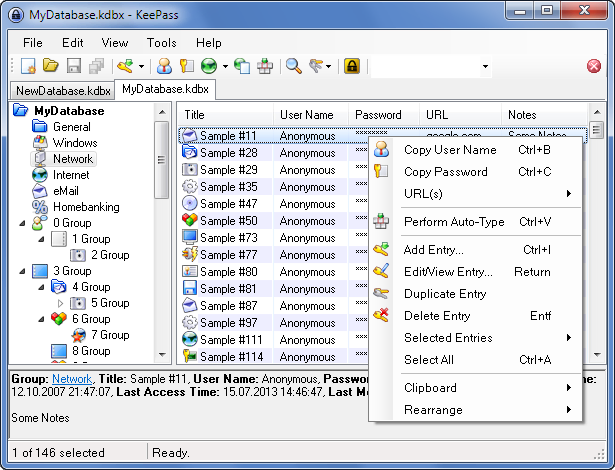
KeePass is a free, open-source password manager that helps you securely manage your passwords. You can store all your passwords in a single database, secured with either a master key or a key file. This way, you only need to remember one master password or select the key file to unlock the entire database.
The databases are encrypted using industry-leading, highly secure encryption algorithms. A password database is stored in a single file, making it easy to transfer from one computer to another.
KeePass encrypts its password databases using the Advanced Encryption Standard (AES, based on the Rijndael algorithm) and the Twofish algorithm.
Both of these ciphers are considered highly secure. For example, AES became a U.S. federal government standard and was approved by the National Security Agency (NSA) for securing top-secret information.
KeePass All Features
KeePass uses the common CSV export format used by various password managers, such as Password Keeper and Password Agent. Exports from these programs might be imported into your KeePass databases. The password list can be exported to various formats like TXT, HTML, XML, and CSV.
The application has a portable edition: you may carry it on a USB stick and run it on Windows systems without installation.
Strong Security
- The app uses the Advanced Encryption Standard (AES, based on Rijndael) and the Twofish algorithm for encrypting its password databases. Both ciphers are considered highly secure. For example, AES became a U.S. federal government standard and is approved by the National Security Agency (NSA) for encrypting top-secret information.
- The entire database is encrypted, not just password fields. This means your usernames, notes, and all other data remain securely protected.
- SHA-256 is used to hash the master key components. SHA-256 is a 256-bit cryptographically safe one-way hash function. No assaults are recognized but towards SHA-256. The output is remodeled using a key derivation function.
- To significantly bolster security against dictionary and guessing attacks, we implement a powerful key derivation function (KDF), such as AES-KDF or Argon2, to transform the master key component. This critical process makes unauthorized access to your data exceptionally difficult, even for sophisticated threats.
- Process memory protection: your passwords are encrypted while KeePass is running, so even when the operating system dumps the KeePass process to disk, your passwords aren’t revealed.
- [2.x] Protected in-memory streams: passwords are encrypted using a session key when loading the internal XML format.
- Security-enhanced password edit controls: KeePass offers password management with enhanced security controls for editing and maintaining credentials. None of the available password edit control spies work against these controls. Passwords entered through these controls stay protected and are not stored in KeePass process memory.
- The master key dialog can be shown on a secure desktop, where almost no keylogger can operate. Auto-Type can also be protected against keyloggers.
What’s New in KeePass 2.61.1 Professional:
- Improved workaround for focus bug after returning from a secure desktop.
- Improved initial application of the ‘Always on Top’ option.
- Improved dialog management.
- Improved HTML viewer initialization.
- Reduced flickering in the ‘Print’ dialog.
- The option ‘Unhide empty data’ (in ‘Tools’ → ‘Options’ → tab ‘Advanced’) is now turned on by default.
- Improved filtering in the field reference creation dialog.
- Improved disposal of process objects.
- Improved performance of the initial key modifier release when performing auto-type on Unix-like systems with XDoTool.
- File transactions involving a base file that does not yet exist but is accessed through a URL no longer fail.
- Various code optimizations.
- Minor other improvements.
What’s New in KeePass 1.43 Classic:
New Features:
- Added option ‘Prevent certain screen captures’ (in ‘Tools’ → ‘Options’ → tab ‘Advanced’, turned off by default); note that this may also prevent legitimate other software (remote desktop solutions, accessibility tools such as screen magnifiers, etc.) from seeing KeePass windows.
- Added {PASSWORD_ENC} placeholder, which is replaced by the password of the current entry in encrypted form (DPAPI/CryptProtectData).
- Added ‘-pw-enc:‘ command line parameter.
Improvements:
- Improved database save confirmation dialog text.
- Improved behavior of the translation system for untranslatable strings.
- Improved project cleanup script.
- Upgraded installer.
- Various UI text improvements.
- Various code optimizations.
- Minor other improvements.
Bugfixes:
- Fixed a Windows detection bug.
Official Homepage – https://keepass.info
Supported Operating Systems: Windows 7, 8, 8.1, 10, 11 (32-bit, 64-bit).