
Get Notified when the Software is Updated

Rufus is a free, lightweight, open-source tool for formatting and creating bootable USB flash drives. It is renowned for being significantly faster than many similar tools. All Rufus versions support USB keys, pen drives, and memory sticks, making it easy to create bootable USB drives from any ISO image.
Use Rufus, especially for cases such as:
- Create USB installation media from bootable ISOs (Windows, Linux, etc.).
- Operate on a system without an installed operating system.
- Run a low-level utility.
- Update BIOS or firmware using a DOS environment.
With readily available CD burning applications like CDBurnerXP and ImgBurn, generating ISO images from discs or files is simple.
Rufus Portable is a USB formatting utility that can also create a bootable USB drive using a bootable ISO image. This app requires admin rights. Despite its small size, Rufus provides everything you want!
Rufus is quick. On occasion, it’s about twice as quick as UNetbootin, Universal USB Installer, or the Windows 7 USB download tool when creating a Windows 7 USB installation drive from an ISO. It can be marginally sooner when creating Linux bootable USBs from ISOs.
Rufus supports a variety of bootable ISO files, including various Linux distributions and Windows installation .iso files, as well as raw disk image files (including compressed ones). If needed, it installs a bootloader such as SYSLINUX or GRUB onto the flash drive to make it bootable. It also supports installing MS-DOS or FreeDOS on a flash drive and creating Windows To Go bootable media. It supports formatting flash drives with FAT, FAT32, NTFS, exFAT, UDF, and ReFS file systems.
Supported Languages: Arabic, Bulgarian, Chinese (Simplified), Chinese (Traditional), Croatian, and Czech. Danish, Dutch, Estonian, Finnish, French, German, Greek, Hebrew, and Hungarian. Indonesian, Italian, Japanese, Korean, Latvian, Lithuanian, Malay, Norwegian, and Persian. Polish, Portuguese (Brazil), Portuguese (Portugal), Romanian, Russian, Serbian (Latin). Slovak, Slovenian, Spanish, Swedish, Thai, Turkish, Ukrainian, Vietnamese
Rufus – Pros & Cons
| Pros | Cons |
|---|---|
| ✓ Creates bootable USB drives from Windows and Linux ISO images, making it useful for installing operating systems and preparing recovery media. | ✗ Requires administrator privileges, which may prevent users with restricted Windows accounts from creating bootable USB drives. |
| ✓ Supports a wide range of disk image formats and can install bootloaders such as SYSLINUX and GRUB when needed for bootable media. | ✗ Runs on Windows 8 and later, so users cannot run it natively on macOS or Linux to prepare bootable media. |
| ✓ Offers multiple file systems, including FAT, FAT32, NTFS, exFAT, UDF, and ReFS, providing flexibility when preparing USB drives for different purposes. | ✗ Formatting or writing an image to a USB drive can erase existing files, so users must back up important data before proceeding. |
| ✓ Includes a portable version that can run without a conventional installation, making it convenient for technicians and users who maintain a collection of system utilities. | ✗ Requires a compatible ISO or disk image for most bootable USB creation tasks, so users may need to obtain or create the appropriate image separately. |
| ✓ Supports specialized tasks such as creating DOS boot media, updating BIOS or firmware from a DOS environment, and preparing Windows To Go drives. | ✗ A bootable USB drive is not guaranteed to work on every computer; compatibility depends on the image, boot mode, and the target system’s firmware settings. |
Frequently Asked Questions
Why won’t a USB created with Rufus boot?
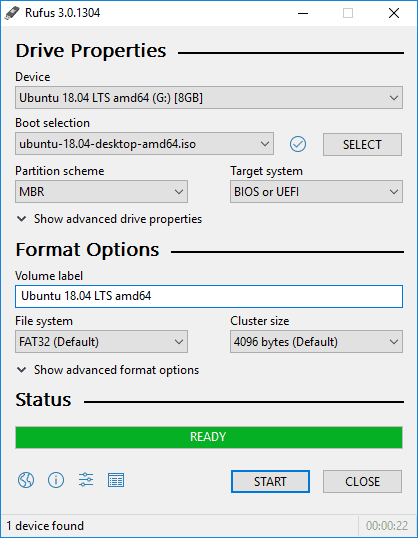
A common cause is a mismatch between the USB’s partition scheme and the computer’s firmware settings. For modern UEFI systems, try selecting GPT and UEFI in the Rufus settings; older BIOS-based systems may require MBR and BIOS compatibility mode.
Can Rufus download official Windows ISO files directly?
Yes, Rufus can download official Windows ISO images through its built-in download option. The option requires an internet connection and the relevant update setting to be enabled, and download availability can depend on access to Microsoft’s servers.
Can Rufus bypass Windows 11 TPM and Secure Boot requirements?
Yes, Rufus can offer options to bypass the TPM 2.0 and Secure Boot requirements when creating Windows 11 installation media. It also provides an option to bypass the Microsoft account requirement in supported setup scenarios, but installing Windows on unsupported hardware may lead to compatibility or support limitations.
How can you restore a USB drive to normal storage after using Rufus?
Open Rufus, select the correct USB drive, choose Non-bootable under Boot selection, and select an appropriate file system before starting the process. This recreates the drive as regular storage, but it erases existing data, so back up any important files first.
What is the difference between Rufus and Ventoy?
Rufus creates bootable USB media from a selected ISO or disk image, making it useful for preparing Windows installation drives and Linux boot media. Ventoy lets you copy multiple ISO, WIM, IMG, and VHD files onto a prepared USB drive and choose which one to boot from a menu. Choose Rufus for creating a dedicated bootable drive or Ventoy for keeping multiple boot images on one USB device.
What’s New in Rufus 4.16:
Release Date 2026-11-17
- Finally, work around the AMI NTFS driver bug so that runtime UEFI media validation can work on the millions of PCs that AMI screwed up
- Finally report USB 3.2+ devices (USB 3.2 = 20 Gbps, USB 4.0 = 40 Gpbs, USB 4.1 = 80 Gbps – See, USB Forum, it’s really NOT that hard!)
- Fix the CA 2023 updated files not being taken into account during runtime UEFI media validation
- Fix the “Silent” installation option being potentially applied even when all dependencies aren’t met
- Fix a regression where “Write as ESP” used the whole drive, instead of the expected 1 GB partition
- Fix WUE timezone duplication for non-English locales and reinstate the use of dots in local usernames
- Add classic right-click context menu restoration to the QoL improvements option (courtesy of Frédéric Lachapelle)
- Drop the ever problematic use of Group Policies when disabling the “Do you want to format this drive?” prompt
- Improve raw image partition (re)mount (courtesy of Jared Hagel)
- Update embedded GRUB to version 2.16
- Update libcdio to the latest
- Update the official DBX URLs, since they were changed by Microsoft
- Address multiple vulnerabilities, courtesy of @indep-arg, Andreas Fehlner, Adam Korczynski, and Ramesh Adhikari
Official Homepage – https://rufus.ie
Supported Operating Systems: Windows 8 and later, both 32-bit and 64-bit.