
Get Notified when the Software is Updated

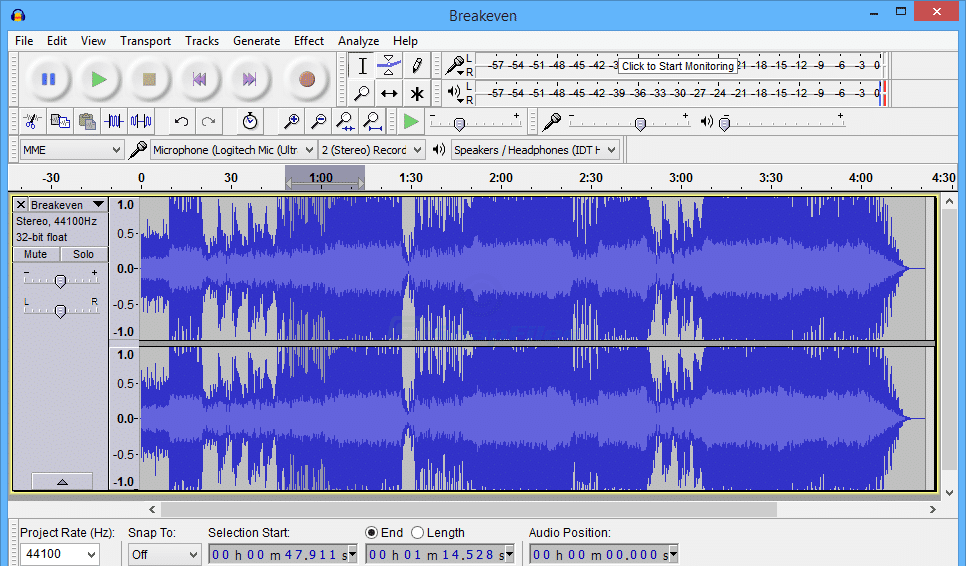
Audacity is a free, user-friendly, multilingual audio editor and recorder compatible with Windows, macOS, GNU/Linux, and other operating systems. It allows you to record sounds, play audio, and import/export WAV, AIFF, AAC, MP4, Ogg Vorbis, MP3, and other file formats.
Use it to edit your sounds with features like Cut, Copy, and Paste (with unlimited Undo), mix tracks together, apply effects to your recordings, change the speed or pitch of a recording, and much more.
Audacity now supports FLAC files and offers a suite of powerful audio analysis tools. These include a built-in amplitude-envelope editor, a customizable spectrogram mode, and a frequency-analysis window for various audio analysis applications.
The program provides a range of built-in effects, such as Bass Boost, Wahwah, and Noise Removal, and crucially, it also offers extensive support for VST plug-in effects.
Audacity is a powerful and user-friendly digital audio editor that can meet the needs of both home users and professionals.
Audacity Key Features
- Cut, copy, splice, or combine sounds collectively.
- Record live audio.
- It supports 16-bit, 24-bit, and 32-bit (floating-point) samples (the latter preserves samples over full scale).
- For recording computer playback on Windows Vista and subsequent versions, ensure you select ‘Windows WASAPI’ as the host in the Device Toolbar, followed by a ‘loopback’ input.
- Import and Export WAV, AIFF, AU, FLAC, and Ogg Vorbis files.
- Convert tapes and records into digital recordings or CDs.
- Edit WAV, AIFF, FLAC, MP2, MP3, or Ogg Vorbis sound files.
- Import and export AC3, M4A/M4R (AAC), and WMA with the optional FFmpeg library (this also supports import of audio from video files).
- Audacity offers a variety of features, including the ability to adjust speed or pitch and perform vocal reduction or isolation (with suitable stereo tracks).
- And more! See the whole list of features.
Audacity – Pros & Cons
| Pros | Cons |
|---|---|
| ✓ Supports recording, playback, editing, and mixing across multiple audio tracks in a single application. | ✗ Some audio formats, including AC3, M4A/M4R, and WMA, require the optional FFmpeg library rather than working through the core installation alone. |
| ✓ Handles common audio formats including WAV, AIFF, FLAC, MP3, Ogg Vorbis, and more, with additional formats available through FFmpeg. | ✗ Recording computer playback on Windows requires selecting Windows WASAPI and configuring a loopback input, which adds an extra setup step. |
| ✓ Includes useful audio effects such as Bass Boost, Wahwah, and Noise Removal, along with extensive VST plug-in support. | ✗ The wide range of editing, effects, plug-ins, and audio-analysis controls can make advanced workflows more involved than basic recording or trimming. |
| ✓ Provides detailed audio analysis through spectrograms, frequency analysis, and an amplitude-envelope editor. | ✗ Some specialized features, such as vocal reduction or isolation, depend on having suitable stereo tracks. |
| ✓ Supports 16-bit, 24-bit, and 32-bit floating-point samples and offers features such as speed and pitch adjustment and vocal reduction or isolation. | ✗ Windows support is listed for Windows 10 and 11, while macOS support starts at macOS 10.9, leaving older operating systems outside the documented requirements. |
Frequently Asked Questions
What is Audacity used for?
Audacity is a free audio editor and recorder for recording, editing, mixing, and processing sound. It includes tools for cutting and combining audio, applying effects, adjusting speed or pitch, and analyzing recordings.
What audio formats does Audacity support?
The software supports common formats such as WAV, AIFF, AU, FLAC, Ogg Vorbis, and MP3. With the optional FFmpeg library, it can also handle formats such as AC3, M4A/M4R, and WMA.
Can Audacity record computer audio?
Yes. On Windows, computer playback can be recorded by selecting Windows WASAPI as the host and using a loopback input. This provides a method for capturing sound played through the computer.
Does Audacity support audio effects and VST plugins?
Yes. The software includes effects such as Bass Boost, Wahwah, and Noise Removal, plus support for VST plug-ins. These capabilities can expand the available options for editing and processing recordings.
What is the difference between Audacity and Ashampoo Music Studio?
The first application is a free, cross-platform audio editor and recorder focused on recording, editing, effects, audio analysis, and plug-in support. Ashampoo Music Studio combines audio editing with music-management tools such as CD ripping, metadata editing, playlists, audio conversion, and disc burning.
What’s New in Audacity 4.0.1
Release Date 2026-09-30
Official Homepage – https://www.audacityteam.org
Supported Operating Systems:
- Windows 11, Windows 10.
- macOS 10.9 and later.